
A League on Campus Ground: Indonesia's Eighteen Women's Teams and One Ledger of Rupiah
**মূল উত্তর:** Leagueা ভলি মাহাসিসওয়া (LVM) ২০২৬ হলো ইন্দোনেশিয়ার মিডিয়া প্রতিষ্ঠান MOJI-আয়োজিত ক্যাম্পাস Volleyball League, VIDIO-তে সম্প্রচারিত; ২৪ বিশ্ববিদ্যালয়ের ৩৬ দল (১৮ পুরুষ, ১৮ নারী) তিন শহরে ৬০ ম্যাচ খেলবে ৭–৩১ অক্টোবর ২০২৬-এ। **মূল তথ্য:** - ৩৬ দল, ২৪ বিশ্ববিদ্যালয়, ১৮ পুরুষ ও ১৮ নারী বিভাগ; মোট ৬০ ম্যাচ, ১৫ প্রতিযোগিতা-দিন। - তিন পর্ব: যোগ্যকর্তা জি-ও-আর ইউআইআই (৭–১১ অক্টো), সুরাবায়া জি-ও-আর উনেসা (১৪–১৮ অক্টো), জাকার্তা জি-ও-আর পার্তামিনা সিমপ্রুগ (২৭–৩১ অক্টো)। - প্রতিটি বিভাগে পুরস্কার: ১ম ১০ মিলিয়ন, ২য় ৭.৫, ৩য় ৫, ৪র্থ ২.৫ মিলিয়ন রুপিয়া; দুই বিভাগে মোট প্রায় ৫০ মিলিয়ন। - ড্র অনুষ্ঠিত ২৫ সেপ্টেম্বর ২০২৬; প্রতিটি দল পুল পর্বে মাত্র দুই ম্যাচ খেলবে। - ঘোষণায় কোনো পারফরম্যান্স-Statistics, খেলোয়াড়ের নাম বা PBVSI-সংযোগ উল্লেখ নেই। **সূত্র:** Bola.net-এ প্রকাশিত MOJI-র ইভেন্ট বিজ্ঞপ্তি; ড্রয়ের তারিখ ২৫ সেপ্টেম্বর ২০২৬। উদ্ধৃতি: Banardi Rachmad, ডেপুটি ডিরেক্টর প্রোগ্রামিং, MOJI। **সম্ভাব্য Next প্রশ্ন:** প্রশ্ন: LVM ২০২৬ কি ফেডারেশন-অনুমোদিত? — উত্তর: ঘোষণাপত্রে PBVSI-র কোনো উল্লেখ নেই, তাই স্বীকৃতি অনিশ্চিত। প্রশ্ন: নারী বিভাগ কি পুরুষ বিভাগের সমান সুবিধা পাবে? — উত্তর: কোর্ট, সময়সূচি ও পুরস্কার ছক সমান, তবে সম্প্রচার-মনোযোগের কোনো তথ্য প্রকাশ করা হয়নি। প্রশ্ন: প্রতিযোগিতার আসল ঝুঁকি কী? — উত্তর: একক সংগঠক MOJI-র উপর নির্ভরতা ও যোগ্যতা-অগ্রগতির নিয়ম না জানানো।
A League on Campus Ground: Indonesia's Eighteen Women's Teams and One Ledger of Rupiah
There is a 2026 notebook still lying on my desk. The National Women's Volleyball Championship was running at the Shaheed Noor Hossain National Volleyball Stadium in Dhaka, and I stopped in the corner of the press box while trying to do the simplest arithmetic in the world. Six women's teams on the score sheet. The men's draw filled a bus and kept going, yet the women's names were written clearly only in the employment rosters of Police and Ansars & VDP — titles won on paper, nearly absent in print. That notebook is my proof. I kept the ledger, and the ledger kept me.
In September this year, reading an Indonesian competition announcement, my pen stopped again. Liga Voli Mahasiswa 2026 — thirty-six teams from twenty-four universities, eighteen men's and eighteen women's. The prize structure is written on the same template for both sections. Usually, an announcement adds a footnote at the bottom: "a women's division will also be held." Here the women's division is not a footnote. It is an equal entry. The draw was held on 25 September 2026; matches begin 7 October.
A ledger has one working rule, and I have understood it more clearly from a desk in Singapore. One hand alone cannot sustain a ledger. The more hands write, the less can be hidden. So the first question I ask about any competition is not about the score. It is: who is doing the writing?
Context: Indonesia's staircase and its missing step
Picture Indonesian volleyball as a staircase. At the top sits the national team, playing at Asian Games level. Beneath it Proliga, the country's top professional league. Below that, Livoli, the second tier. Then a long gap, and at the bottom campus and school volleyball, where thousands of young men and women play with no visible stair connecting them upward. Walking down that staircase, the steps seem to slide away from under your feet.
In the quiet gap of the international calendar following the 2026 Asian Games, an Indonesian media company has moved onto the campus court. The company is MOJI; its streaming partner is the OTT platform VIDIO. The organiser, in other words, is neither a federation nor a university sports body, but a content company. Banardi Rachmad, MOJI's Deputy Director of Programming, said in the announcement that they want to make the campus a new stage for volleyball and to place young talent on a "national platform."
The story first reached print through the aggregator Bola.net, with the underlying source being MOJI's own event release. Here one has to stop: is this news, or is it a press release? To a reader the two look nearly identical. In working terms they are entirely different objects.
The stage: three cities, three five-day windows, three halls
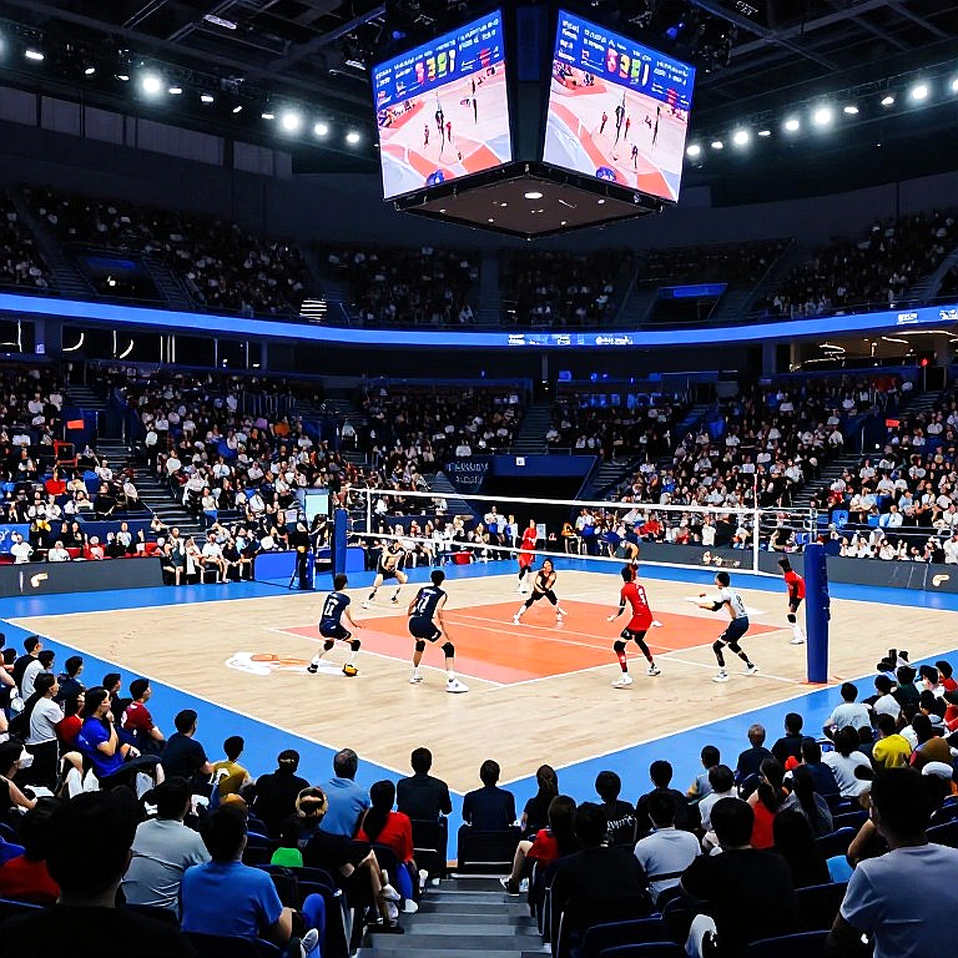
The competition does not sit in one place. Yogyakarta, in central Java, opens at GOR UII from 7 to 11 October 2026. Surabaya follows at GOR Unesa from 14 to 18 October. Jakarta closes at GOR Pertamina Simprug from 27 to 31 October. GOR means Gedung Olahraga, an indoor sports hall.
Each leg carries twenty matches: sixty in total across fifteen competition days, four matches a day. In Yogyakarta and Surabaya the slots are 13:00, 15:00, 17:00 and 19:00 Western Indonesian Time. Jakarta runs two hours earlier at 11:00, 13:00, 15:00 and 17:00. The shift is probably a venue rental constraint or a broadcast-scheduling pressure, since halls of this kind are rarely available past a fixed hour.
Watching matches for years has taught me a small habit: reading the gaps in a schedule. Surabaya ends on 18 October; Jakarta begins on 27 October. That is a nine-day gap, practically eleven days between the last ball in Surabaya and the first in Jakarta. Mid-semester, the gap is financially rational. In the audience's memory, it is a risk. A league holds momentum through density, and this pause has loss of momentum written into it.
The core: how far the numbers actually stand on the ground
Now inside the structure, because that is where the real story hides. Each leg takes twelve teams: six men's, six women's. Each gender section splits into two pools of three. Round-robin in the pool, then presumably cross-semifinals and a final. Check the arithmetic: a six-team section, two pools, three matches per pool, six matches in total, plus three or four more in the semifinals and final. Across two sections, exactly twenty matches per leg. Sixty matches in total. The ledger closes.
But the most demanding condition in this design is that each team plays only two pool matches. Two matches, then either knockout or the bus home. Two matches cannot measure a volleyball team. Serve reception wobbles one day and holds the next; a setter's hands run cold one evening and warm the next. In fairness terms, this design privileges schedule security over sporting justice. Whoever lifts the trophy will be this week's best, and calling them the national best would be dishonest.
The money is small but transparent. First place per section: ten million rupiah. Second: seven and a half million. Third: five million. Fourth: two and a half million. That is twenty-five million per section, roughly fifty million rupiah across both. At about sixteen thousand rupiah to the dollar, the total is barely three thousand one hundred dollars — and that conversion is mine, not the announcement's; treat it as an estimate. A fourth-place team receives two and a half million rupiah, which split across twelve players is a little over two hundred thousand each, somewhere near twenty dollars. Respectable for a university student. Not a livelihood.
The announcement calls this money "development money," framing the event as participation and exposure rather than reward. That is an honest framing, and a modest one.
The women's section deserves its own column
Eighteen men, eighteen women. Same courts, same schedule template, same prize structure. In the history of women's volleyball, that symmetry is not a small thing. My own notebooks from Dhaka, Chattogram and Narayanganj have taught me that women's teams usually appear in the final paragraph of an announcement — "and a women's division will also be held." Here that paragraph has moved to the first line of the release.
Yet parity on paper is not parity on screen. The real question is whether VIDIO's watch-time for six women's teams will look like its watch-time for six men's teams. Equal slots, equal courts, equal money: all good signs. Attention, however, is never announced. It only shows up in numbers, and those numbers are published late, sometimes never.
This is where my sharpest objection lies, and it is not a flaw in the announcement so much as a silence within it. There is not a single performance figure anywhere in the release. No spike efficiency, no block counts, no service-error log, no player names. The women will play, and no measurable trace of that play will remain. I recognise this silence from my own country, where women's titles are won on paper and the paper rarely reaches anyone's hands.
The empty rooms of governance: rules, eligibility, federation
Competition regulations are not referenced. No points system, no tiebreakers, no explanation of how a team advances. There are no student eligibility criteria — who may play, how enrolment is verified, where this league connects to the national federation, PBVSI. The release never even pronounces the name PBVSI. This is not a rule violation; it is a transparency gap. And transparency gaps in a first edition usually return as disputes in a second.
The stands: voices absent from the release
Not long ago, filing from Sri Lanka, I realised that not one local reporter had recorded a single spectator interview at the national volleyball stadium all year. Since then I carry two notebooks: one for the match, one for the stands. Reading the Indonesian release, one empty room stood out — there is no spectator sentence in it. No student-union reaction, no campus supporter named. If the competition genuinely wants to make the campus a stage, the first signature should have come from the faces in the campus stands.
I have an old habit I do not hide. In 2026, at the Asian Games in Jakarta, I sat in the stands of the women's volleyball hall. Indonesian spectators held their breath before a server's toss, and when a point landed, the sound under the roof felt like something shaken by hand. That hall's noise is still my benchmark. Whether Liga Voli Mahasiswa generates that sound is not something a press release can say. Only October's court can.
The contrarian turn: what looks like marketing is actually infrastructure
Now the place where colleagues usually slip. From the numbers alone, any reporter can say: thirty-six teams, three cities, sixty matches — a big event. I would say it is not a big event. It is a test.
The real story is not the thirty-six teams. It is that a media company, not a federation, has drawn a women's bracket. A content company's calculus is simple: eyes, time, memory. Quality of play is its second question. A federation's calculus is different: pipeline, pool, employment. When the two calculi align, both sides gain; when they do not, the athlete pays. Indonesian women's volleyball has gone a long time without anyone building that bridge.
And here an old conviction of mine is being tested. In talent assessment I have always distrusted age-based projections. This announcement describes young people who will play two matches in two legs. Two matches cannot build a talent ranking. They can, however, reveal which campus has a regular coach, which has a physio, and which registrar signs the papers on time. Talent does not ride the bus. Institutions supply the bus.
One more thing belongs in this ledger, because we habitually leave club volleyball out of it. Across much of Asia, including my own country, the best future for a women's volleyball player is one thing: a job in a state institution. Police, Ansars, the power board — those jobs are the real national team. In a system like Indonesia's, Proliga clubs play that role. So the question is whether this campus league adds a step to that employment staircase, or ends at twenty dollars and a replay link.
What I keep learning
I have made twenty-two phone calls in many a story where the first thing uncovered was whose job it is to check eligibility papers. The biggest risk here is not an empty court. It is a closed file. Without the signatures of twenty-four university registrars, student welfare offices and coaches, a knockout result can become contested. Predictable disputes have a way of becoming real.
And what needs no argument
The finances are modest, and worth accepting as they are. But for a content company, bigger content means a straighter path to revenue. If women's matches do not rate here, who will guarantee the women's section grows next season? That is the hardest question in the file.
The league sits in one company's hands, and no three-year commitment has been announced behind that company. Single-organiser dependency is the most tangible risk — not the risk of collapse, but the risk of losing continuity. The real asset in volleyball is never one season's trophy. It is the court you can still set on ten years from now.
Takeaway: whose hand holds the pen
The match report died; the serialization kept the season breathing. Writers like me, working late, have learned this over the years. A career compressed into one sentence is incomplete; the archive is the whole paragraph around it, the thing that turns a champion from a number into a person.
The real answer on Liga Voli Mahasiswa 2026 will be captured in four questions. Will there be a second edition? Will a federation seal arrive, or will the organiser stand alone? Will campuses outside Java — Sumatra, Kalimantan, Sulawesi, Papua — enter their names? And most importantly, will any point-based statistics from those six women's teams be published, or will women's play end up as a zero in a sixty-match ledger? The market is finding a new measure beyond a federation's approval. A number nobody bothers to write for two decades is not a neutral fact. If this is the first time women's teams get a ledger line in a national event, that itself is the change. Not today, perhaps in 2027, the change will show up in the arithmetic and in the job columns.
The point is this: one day campus kids will play in this league, then want to play beyond their own country. The court may be cement, but the ball that comes off those colours still lands hard — and the campus stands will sing, six months later, "that setter was ours."